


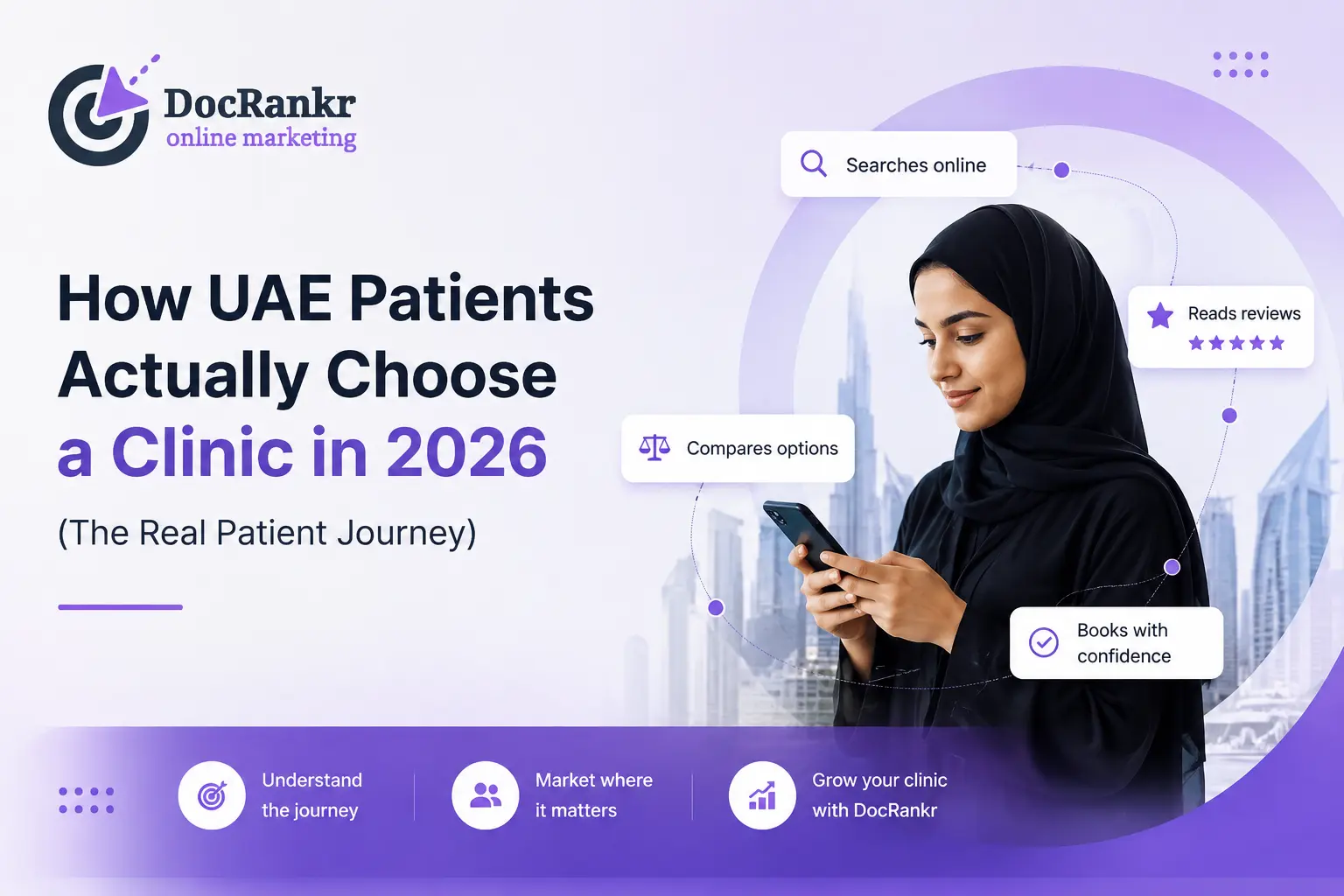
The UAE is one of the most connected countries on earth. Internet penetration sits at roughly 99%, about 96% of internet users get online via a smartphone, and mobile devices drive nearly three-quarters of all web traffic. For a clinic, that means one thing: your waiting room fills — or stays empty — based on what happens on a small screen in a patient’s hand, long before they call.
Yet most clinic owners still picture the old journey: a patient gets a recommendation from a friend and calls to book. That journey is mostly gone. Here’s what actually happens now — stage by stage, with the data.
The modern path from “I need a doctor” to “I’ve booked” runs through five digital touchpoints. A patient can drop off at any one of them. Miss a stage, and you’re quietly removed from the running without ever knowing you were in it.
When a UAE patient needs care, their instinct isn’t to ask a neighbour — it’s to open Google on their phone. Around 77% of patients use a search engine before booking, and of those, roughly 71% choose a provider they discovered through those search results (Appeario, 2026). The query is specific and local: “dermatologist in Sharjah,” “best dental clinic Ajman,” “orthopedic doctor near me.”
If your clinic doesn’t appear on that first page of results for your service and your emirate, you’re not a weak option — you’re simply not an option at all. The patient never sees you.
Once a patient has a few names, reviews do the filtering. This is the most underestimated stage in UAE healthcare, and the numbers are stark. About 84% of patients read online reviews before choosing a provider, and over half read six or more before feeling confident (rater8, 2025). It’s not just star ratings — patients read for wait times, bedside manner, and how the clinic responds to criticism.
Global patient-research surveys, 2025–2026 (rater8, Tebra)
Read that last bar again: for around 61% of patients, negative reviews can override even a personal recommendation from friends or family. A clinic with a 4.7 rating and 180 recent reviews will almost always beat a clinic with a perfect 5.0 and only 9 — patients trust volume and recency over a thin flawless score.
Before booking, patients visit your website and scroll your Instagram — and they judge fast. On a mobile-first population, a site that loads slowly, looks dated, or hides your contact details reads as a warning sign. Roughly 35% of patients say they’ve chosen a doctor based on social media presence (rater8), while an inactive page — last posted two months ago — signals a clinic that may be equally inattentive in the exam room.
This stage is pure perception. Your clinical excellence is invisible here; only your digital presentation speaks.
This is the stage almost no UAE clinic is ready for. Patients now ask ChatGPT, Gemini and voice assistants to shortlist for them: “What’s the best pediatric dentist in Sharjah?” Around 70% of patients are open to using AI to research a physician, and a large majority adopted new research tools — including AI chatbots — in just the past year (Medical Economics; rater8, 2025).
Here’s the uncomfortable part: if an AI tool doesn’t recognise your clinic, it recommends your competitors — and you never even see the search happen. Being citable by AI is quickly becoming as important as ranking on Google.
When a UAE patient is finally ready, they rarely dial. With WhatsApp penetration near 90%, messaging is the default. They tap “Chat on WhatsApp,” ask a quick question, and book. A clinic with no visible WhatsApp option adds friction at the exact moment of highest intent — and loses the patient to the competitor who’s one tap away.
The through-line is simple: the entire decision now happens before the phone rings, across five digital moments you mostly can’t see. You don’t need to win on price or even on being the best-known name — you need to be present and trustworthy at each stage. Here’s how the journey maps to what your clinic actually needs in place:
| Stage | What the patient does | What your clinic needs |
|---|---|---|
| Search | Googles the service + emirate on mobile | Local SEO & first-page ranking per emirate |
| Evaluate | Reads 6+ reviews, judges star volume | A steady stream of recent Google reviews |
| Interview | Visits your site & social to judge trust | Fast, modern, mobile-first website + active social |
| Ask AI | Asks ChatGPT/voice for a shortlist | AEO — being citable by AI engines |
| Contact | Messages before calling | Visible WhatsApp button on every page |
Most clinics in the UAE are strong on the one thing patients can’t see yet — clinical care — and weak on the five things that decide whether a patient ever arrives. Close that gap, and a full waiting room stops being about luck.
Most start on a smartphone — searching Google, reading reviews, checking your website and social media, and increasingly asking AI tools like ChatGPT. With internet penetration around 99% and mobile driving most web traffic, discovery is mobile-first and happens well before any phone call.
Yes — heavily. Around 84% of patients read reviews before choosing a provider, and many read six or more. About 40% have avoided a booking after negative reviews, and a majority say bad reviews can outweigh even a friend’s recommendation.
Increasingly, yes. Roughly 70% of patients are open to using AI to research physicians, and most adopted new research tools including AI chatbots in the past year. Clinics invisible to AI are missing a fast-growing discovery channel.
Critical. WhatsApp penetration in the UAE is around 90%, and many patients prefer to message before calling. No visible WhatsApp option adds friction at the moment of highest intent and often costs you the booking.
Effectively, yes. About 77% of patients use search before booking and rarely look past page one. If you don’t appear for your service in your emirate, you’re not in the running — regardless of how good your care is.
We run a free digital audit for UAE clinics across Sharjah, Ajman, RAK, Dubai & Abu Dhabi — an honest look at where patients lose you across all five stages. No pitch, just the fixes.
Sources: DataReportal — Digital 2025: United Arab Emirates; rater8 2025 Patient Choice Report; Tebra 6th Annual Patient Perspectives Report (2025); Zocdoc booking data (2025–2026); Appeario patient search behaviour (2026); Medical Economics (2026); Infobip WhatsApp statistics (2025). Figures reflect global and UAE patient-research studies and are indicative of behaviour patterns rather than clinic-specific outcomes.


Explore Docrankr quick links for essential healthcare marketing insights, services, resources, and tools designed to help clinics grow digitally.
© Copyright 2023 By Docrankr.ae
Error: Contact form not found.