


A dermatology clinic owner in Dubai Marina sat across from me last spring, laptop open, looking genuinely confused.
Her website ranked number one for her main keyword. First result, above the map pack, the works. And her new-patient bookings had been flat for five months.
We pulled up her analytics together, and the traffic was there. People were finding the page. They weren’t calling.
So I asked her to do something simple: open ChatGPT and type the question a real patient would type — “best clinic for acne scars in Dubai.” Her clinic wasn’t mentioned.
Not in the answer, not in the sources, nowhere. Three of her competitors were. One of them ranked on page two of Google.
That was the moment it clicked for her, and it’s the reason I’m writing this. The rules changed quietly, and most clinics in the UAE haven’t noticed yet.
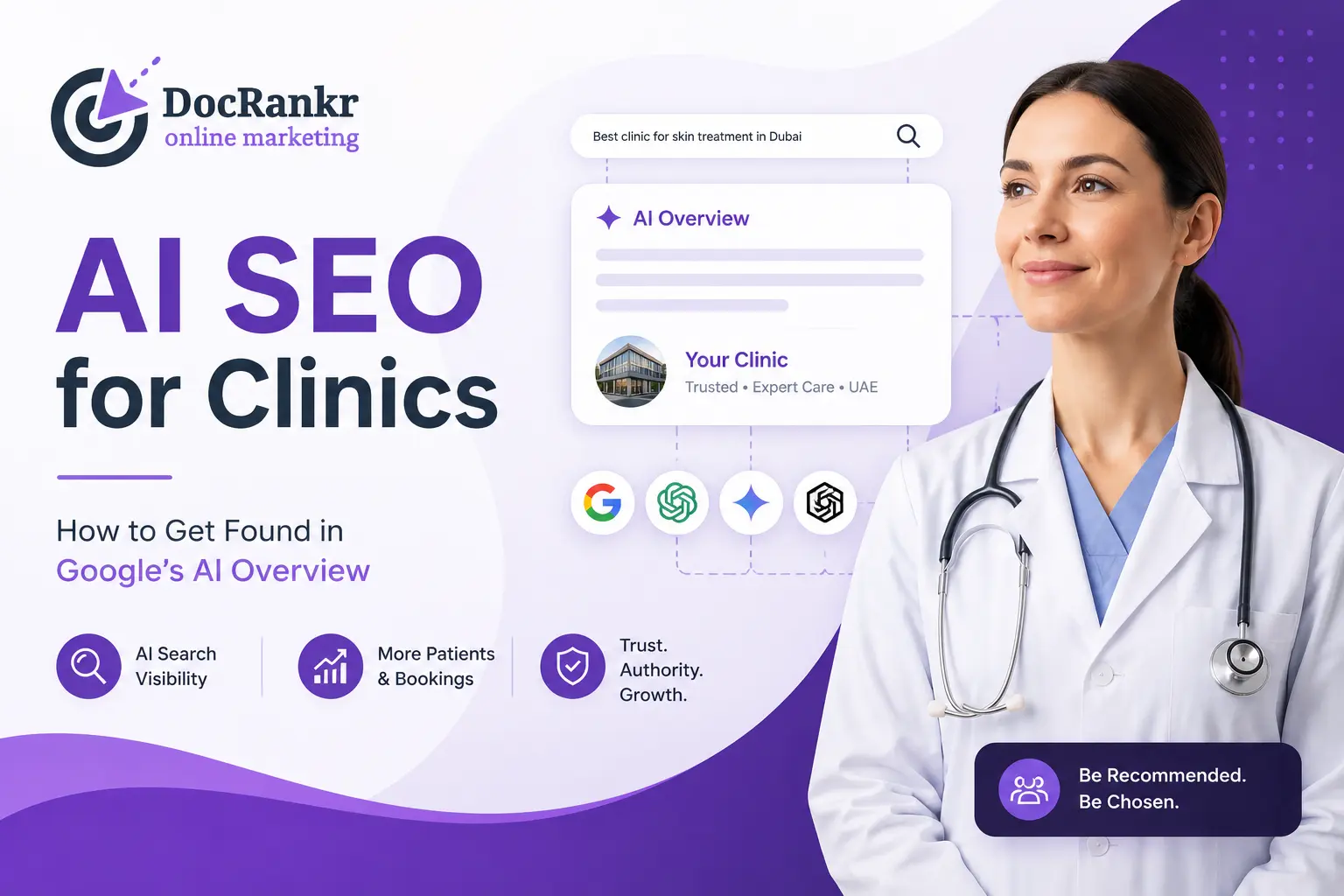
AI SEO for clinics is the practice of optimizing a medical website so it ranks in traditional Google search *and* gets recommended by AI search tools like Google’s AI Overviews, ChatGPT, Gemini, and Perplexity.
You’ll hear this discipline called a few different things: AI search optimization for healthcare, AI-powered SEO, generative engine optimization, or simply ChatGPT SEO for doctors.
Don’t get attached to the label. Whatever you call it, AI search optimisation for doctors comes down to a single question: when a patient asks an AI tool about your specialty, are you in the answer?
For a clinic, that means combining local SEO, medically accurate content, structured data, and compliance with UAE healthcare advertising rules , so both Google and AI engines trust you enough to send patients your way.
Here’s what I’ll cover, based on what I’ve actually watched work (and fail) over the past decade running healthcare campaigns across Dubai, Abu Dhabi, and Sharjah.
What AI SEO means for a clinic specifically, where your patients are searching now, the credibility trap that catches medical sites, how to stay on the right side of DHA and DoH rules while you do it, the Arabic-English problem nobody talks about, and a workflow you can actually use.
By the end you’ll know whether this is something your team can handle in-house or whether you need help.
Let’s get into it.
I want to clear something up first, because there’s a lot of nonsense being sold right now.
AI SEO does not mean “feed ChatGPT a prompt, publish whatever it spits out, and watch the rankings roll in.” If anything, doing that on a medical website is one of the fastest ways to damage your visibility.
I’ll explain why in a bit.
Real AI SEO for healthcare is two jobs running at the same time.
The first job is the one you already know: ranking in Google’s blue links and the local map pack, so when someone searches “pediatric dentist in Jumeirah,” your clinic shows up.
The second job is newer and most clinics are completely ignoring it — getting your clinic named and cited inside AI-generated answers.
When a patient asks ChatGPT or Google’s AI Overview “where should I go for IVF in Abu Dhabi,” you want to be one of the clinics the AI mentions.
Find out if ChatGPT, Gemini, and Google’s AI Overview recommend your clinic—or your competitors.
Those two jobs overlap, but they’re not identical. I’ve seen clinics that rank beautifully in Google and get zero AI mentions, and I’ve seen smaller clinics that punch above their weight in AI answers because their content was structured in a way the models could actually understand and trust.
The myth I hear most often is “AI will write all our content and we’ll rank automatically.” The reality is closer to the opposite.
As AI-generated content has flooded the internet, Google and the AI engines have gotten better at spotting thin, generic, unverified medical content and quietly ignoring it.
The clinics winning right now are the ones using AI to work faster while keeping a human medical expert firmly in control of what gets published.
Speed from the machine, judgment from the human. Get that balance wrong on a health site and you pay for it.
Think about how you’ve personally looked something up in the last month.
I’d bet money at least one of those searches happened inside ChatGPT or an AI Overview instead of a normal Google results page.
Your patients are doing the same thing, and the shift is faster in younger, more digital-first markets — which describes the UAE almost perfectly.
When someone opens an AI tool and asks a health question, the model doesn’t show ten links.
It gives an answer, and maybe names a few clinics or cites a few sources. If you’re not in that answer, you don’t exist for that patient.
There’s no “scroll down to see more.” That’s the whole game now, and it’s why ranking number one stopped being enough for that Dubai dermatology clinic.
The discipline of getting recommended inside these AI answers has a name: generative engine optimization for clinics, sometimes shortened to GEO, and you’ll also hear AEO (answer engine optimization).
Don’t get hung up on the acronyms. The practical question is simple: when an AI tool answers a patient’s health question, does it mention you, and does it trust your website enough to use it as a source?
Here’s a test I run with every new clinic I work with, and you can do it yourself in ten minutes.
Nine times out of ten, my new clients aren’t in a single answer, and they’re shocked, because they assumed good Google rankings meant good AI visibility.
They don’t. They’re related but separate, and you have to earn both.
Discover exactly where competing clinics outrank you in AI search, Google, and local results.
Remember the Dubai Marina dermatologist I opened with? That wasn’t a random example. Dermatology and aesthetic clinics tend to feel the AI-search shift before anyone else in the UAE, and it’s worth understanding why.
Patients researching acne scars, laser hair removal, Botox, or a hair transplant ask AI tools long, comparative questions ,
“Which is better for acne scarring, subcision or laser?” is exactly the kind of question an AI Overview loves to answer, and exactly the moment a plain Google ranking does nothing for you.
It’s also why the dermatologists and derma clinics that come to us rarely need convincing about rankings; they already rank.
What they’re really looking for are SEO experts for derma clinics who understand that visibility now lives inside AI answers, not just blue links.
If you’re a dermatologist searching for SEO consultants who actually get this, use one test: ask them to show you where your clinic appears when a patient asks ChatGPT about your top treatment.
If they can’t, they’re doing 2020 SEO for a 2026 problem.
This is the section I beg clinic owners not to skip, because it’s where I’ve seen real damage done.
Google treats health content differently from almost everything else. Internally, it falls under what’s called YMYL — “Your Money or Your Life” — the categories where bad information can genuinely hurt someone.
Medical advice sits right at the top of that list. For these pages, Google leans hard on signals it groups under E-E-A-T: experience, expertise, authoritativeness, and trust.
In plain terms, Google wants to know that a real, qualified person stands behind your medical content, and the AI engines have inherited the same instinct.
Here’s where clinics get burned.
A practice manager, trying to keep up, generates twenty blog posts with AI in an afternoon and publishes them. The articles read fine on the surface.
But they have no named author with medical credentials, no evidence anyone qualified reviewed them, and — this is the dangerous part — they occasionally contain confident medical claims that are subtly wrong, because the model made them up.
On a recipe blog that’s an annoyance. On a clinic website it’s a liability, and the search engines treat it as a trust problem and bury the whole site, good pages included.
I watched this happen to a dental group in Abu Dhabi before they came to us. Their previous “SEO guy” had published dozens of AI-written articles.
One post confidently described a treatment protocol that no dentist on their team would ever recommend. A patient could have read it and made a decision based on it.
We pulled the content, rebuilt it with their lead dentist reviewing every clinical claim, and added proper author bios with credentials.
Visibility recovered over the following months, but it was a painful, avoidable detour.
So the rule on a medical site is non-negotiable: AI can help you draft and organize, but a credentialed human reviews every clinical statement before it goes live, and you show the world who that human is.
That review isn’t bureaucratic overhead. On a YMYL page, it’s a ranking factor, and it’s the single biggest thing separating clinics that win at AI SEO from clinics that quietly tank.
Almost every article you’ll read about AI SEO was written for a US or European audience, and it leaves out something that matters enormously here: medical advertising in the UAE is regulated.
Health-related promotion falls under the relevant health authorities depending on your emirate — the Dubai Health Authority (DHA) in Dubai, the Department of Health (DoH) in Abu Dhabi, and the Ministry of Health and Prevention (MOHAP) federally.
Broadly speaking, certain health and medical advertising requires permits, and there are rules about the claims you can make.
Superlative and guarantee-style language — “the best,” “100% safe,” “guaranteed results,” “painless,” before-and-after promises — is exactly the kind of thing that gets clinics into trouble, and it’s also exactly the kind of language AI writing tools love to produce by default.
Do you see the collision? The same AI that helps you publish faster will happily generate marketing copy that violates your advertising permit conditions, because it doesn’t know or care about UAE healthcare regulation.
I’ve caught draft content that promised “guaranteed pain-free treatment” more times than I can count. Published, that’s not just bad SEO, it’s a compliance risk for the clinic and the licensed practitioners behind it.
This is genuinely good news for you, though, and here’s the strategic part. Because nearly all AI SEO content online ignores UAE medical-advertising rules, there’s almost no competition for content that addresses them properly.
A clinic that publishes clear, compliant, genuinely helpful content — written to inform rather than over-promise — looks more trustworthy to both regulators and AI engines at the same time.
Restraint becomes a ranking advantage. I’d treat your compliance knowledge as a competitive moat, not a constraint.
One honest caveat: the specifics of permits and approved claims change, and they vary by emirate and treatment type.
Don’t take a blog article’s word for what’s currently allowed — confirm the current rules with the relevant authority or your compliance advisor before you publish marketing claims.
I’m giving you the principle; verify the details.
Here’s a question I ask every UAE clinic that wants to be serious about AI SEO: what happens when a patient searches in Arabic?
For a lot of clinics, the answer is “nothing good.” The website is English-only, or the Arabic version is a clumsy machine translation that reads awkwardly to a native speaker.
Meanwhile a meaningful share of the patient population searches and asks AI tools in Arabic, and the AI engines are getting better at Arabic medical queries every month.
When someone asks an AI assistant a health question in Arabic and you have no credible Arabic content, you’re invisible to that patient before the conversation even starts.
And proper Arabic SEO is not “run the English page through a translator.” It involves how the language is actually searched, transliteration of treatment names, the right-to-left structure of the page, and content that a native Arabic-speaking patient finds natural and trustworthy.
That last part matters as much for AI as it does for humans — clumsy translated content reads as low-quality, and the models notice.
The clinics getting this right in the UAE are building genuine parallel content in both languages, reviewed by people fluent in each.
It’s more work. It’s also why a thoughtful local clinic can out-perform a generic global competitor that treats Arabic as an afterthought.
If your patient base is bilingual and your content isn’t, that’s probably your biggest unclaimed opportunity.
Receive a personalized strategy showing how your clinic can earn more AI citations, rankings, and patient inquiries.
Enough theory. Here’s the workflow I use, stripped down to what matters. You can adapt it whether you’re doing this yourself or briefing a team.
Start with patient questions, not keywords. Use AI tools to expand your research, but anchor everything to the real questions patients ask — pulled from your front desk, your DMs, your consultation notes. AI is excellent at clustering these into topics and spotting gaps. It’s the fastest part of the job and the one AI genuinely improves.
Draft with AI, gate with a human. Let AI produce a structured first draft to save time. Then a credentialed clinician reviews every medical claim, and an editor makes it sound like a human wrote it. Strip out the over-promising, the fake confidence, and anything that brushes up against your advertising rules. Nothing clinical gets published without that review. This single gate is what protects you from the credibility trap above.
Win local, because clinics are local. Your Google Business Profile is doing heavy lifting you might be ignoring. Keep your name, address, and phone number identical everywhere online, collect reviews consistently and respond to them, and keep your profile current. AI tools lean on these local signals when they decide which nearby clinic to recommend. A neglected Business Profile quietly sinks you.
Get the technical layer right with medical schema. This is the unglamorous part that moves the needle. Structured data — schema markup — is how you spell out to Google and AI engines exactly what you are: a medical clinic, with these doctors, these services, at this location, answering these questions. Clinics that mark up their pages properly get understood and cited more reliably. I’ve put filled-in schema blocks at the bottom of this article that you can adapt and hand straight to your developer.
Measure AI visibility, not just rankings. Keep tracking the old metrics — rankings, organic traffic, and the one that actually pays the bills, booked appointments. But add a new habit: every month, run your five patient questions through ChatGPT, Gemini, and AI Overviews and record whether your clinic gets named. That “AI citation share” is the leading indicator nobody’s watching yet, which is exactly why watching it gives you an edge.
If you run that loop honestly for ninety days, you’ll see movement. Not overnight — anyone promising you overnight medical SEO results is the same person who’ll publish twenty unreviewed AI articles and call it strategy.
I’ll be straight with you, even though I run an agency. Plenty of this you can do yourself, especially the local SEO basics and the patient-question research.
If you have a marketing person with genuine SEO skills and a clinician willing to review content, start there.
You should think about hiring a specialist when the compliance, bilingual, and technical pieces start eating time you don’t have — which, for most clinic owners, is roughly week three.
When you’re evaluating an AI SEO agency in the UAE, here’s what separates the real ones from the rest. They should talk about your patients and your numbers before they talk about tools.
They should understand DHA and DoH advertising rules without you explaining them. They should insist on clinician review of medical content rather than treating it as optional.
And they should be able to show you, plainly, how they’d get your clinic cited in AI answers, not just ranked.
The red flags are just as clear: anyone guaranteeing a specific ranking by a specific date, anyone who wants to publish AI content at volume without medical review, and anyone who can’t explain in plain language what they’d do differently for a clinic versus a plumber.
Healthcare is not a generic vertical. If they treat it like one, walk.
The clinics that will own patient search over the next few years aren’t the ones with the biggest budgets.
They’re the ones who noticed the shift early and did the unglamorous work well — accurate content with a real expert behind it, clean local signals, proper schema, content in the languages their patients actually use, and marketing that respects the rules instead of fighting them.
That’s what AI SEO for clinics really comes down to. It’s less about chasing the newest tool and more about being genuinely trustworthy in a way both patients and machines can verify.
If you want to know exactly where your clinic stands right now, do the ten-minute test from earlier: run your five patient questions through ChatGPT, Gemini, and Google’s AI Overviews, and see who gets mentioned. If it’s not you, that’s not a failure — it’s a head start, because most of your competitors haven’t even looked.
When you’re ready for the full picture, DocRankr offers a free AI Visibility Audit for UAE clinics. We’ll show you where you’re appearing in AI answers and search, where your competitors are beating you, and the specific, compliant steps to fix it.
No jargon, no guarantees we can’t keep — just a clear read on where you stand and what’s worth doing first.
**Get your free AI Visibility Audit →**


Explore Docrankr quick links for essential healthcare marketing insights, services, resources, and tools designed to help clinics grow digitally.
© Copyright 2023 By Docrankr.ae
Error: Contact form not found.